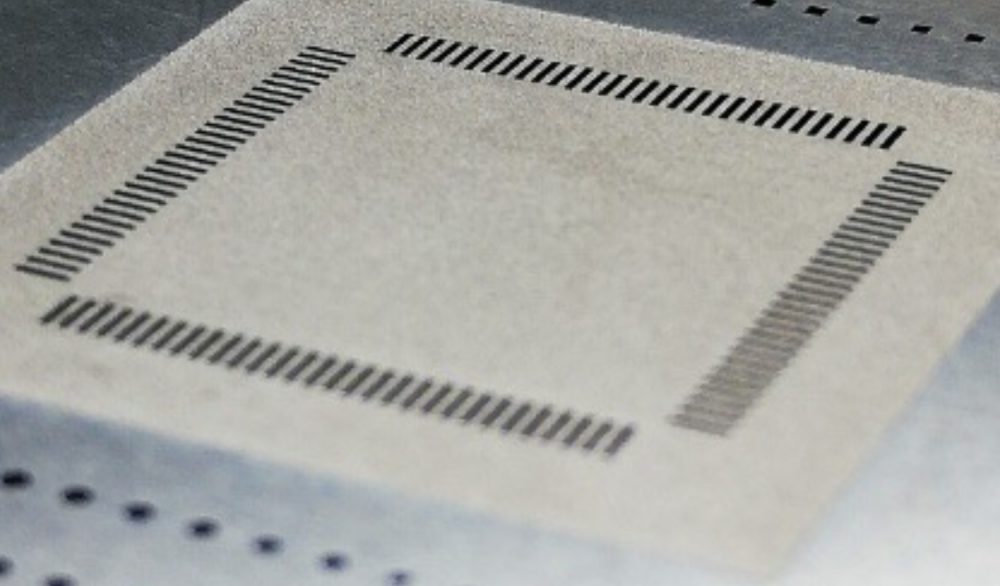
Half etching ( Step-Down / Step-Up ) processing
Recently, it has been gaining renewed attention as a new technique,
not only for adjusting solder volume but also for providing clearance
for PCB irregularities and enabling double or multiple printings.
Our half-etching technology provides the latest specifications that have significantly improved “processing accuracy and enables to accomodate such a wide range of applications.”
Main Applications and Processing Examples
1.Adjustment of solder volume
The stepped stencil allows adjusting solder volumes by partially varying the thickness of the stencil.
Also, it is possible to stabilize the printability of various opening sizes by partially changing the area ratio of opening apertures.
a)Squeegee-side step down / step up
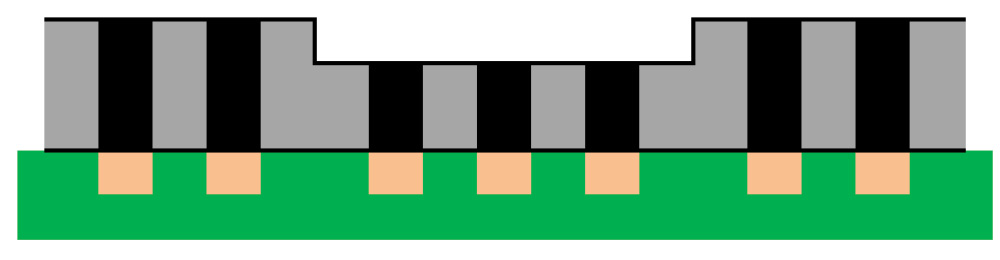
① This is the most common shape.
This type of stencil is generally used in combination with a rubber squeegee utilizing the deflection of the squeegee for printing.
- This type of stencil is occasionally used with a metal squeegee.
- This shape is effective when there are a variety of different opening sizes, especially the size difference is significant.
- Recently, this shape has been widely used for small capaciters and resisters, such as chips size 0402 or smaller.
② As with ①, printing is performed by utilizing the deflection of the urethane squeegee.
Unlike ①, it is rarely used with a metal squeegee.
- This shape is effective for increasing the solder volume of components that require sufficient strength, such as connectors and shields.
b)PCB-side step down
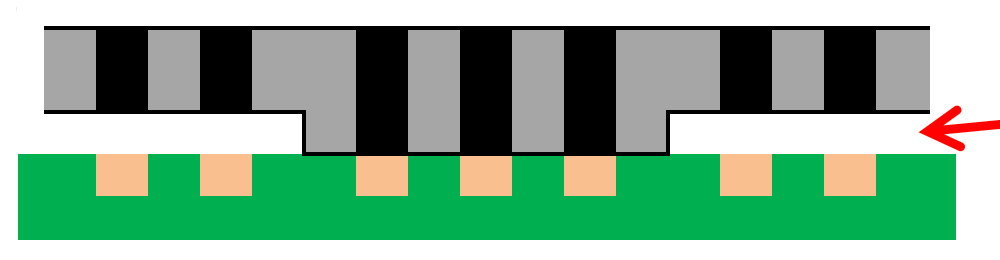
③This shape is effective when printing with a metal squeegee to achieve an effect equivalent to that of shape ②.
- The stencil does not come into direct contact with the PCB, printing is possible by pressing and deflecting the stencil downward with a metal squeegee in order to bring the stencil into contact with the PCB.
- It is rarely used with a rubber squeegee, as it cannot withstand the pressing force.
2.Improved PCB contact and clearance for protrusions
If the PCB surface is uneven, such as when there are components mounted on it, the stepped down stencil is useful to make contact with uneven PCBs.
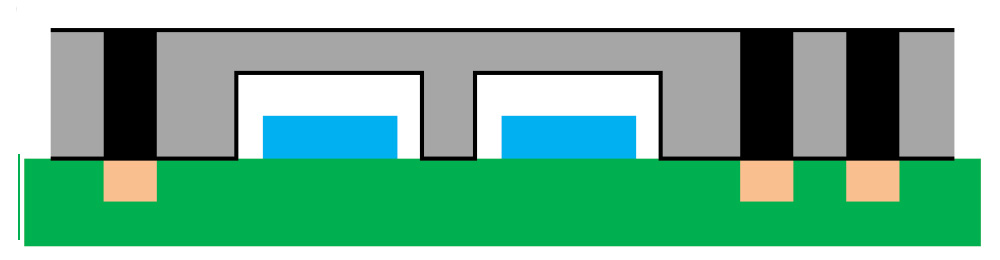
It is used to provide clearance for PCB irregularities, and is also expected to be utilized in the future by avoiding mounted small chips for printing.
- For cases with large clearance heights, COB stencil is recommended.
High-precision half-etching example
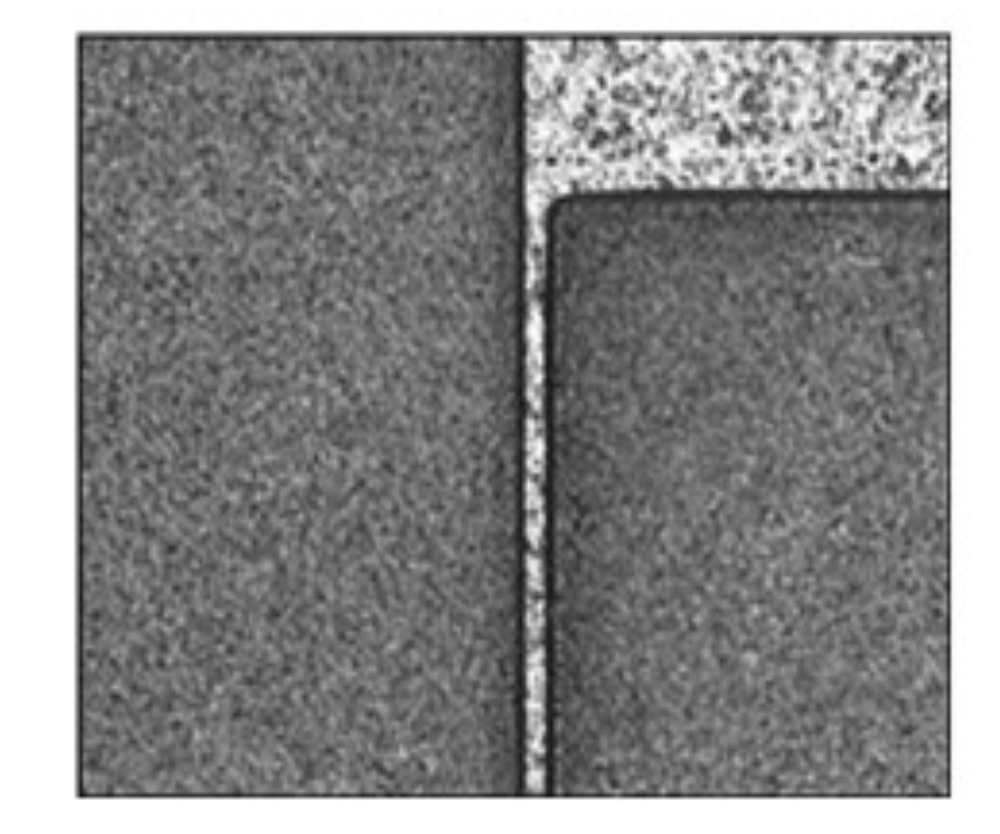
The gray area in the left figure is half-etched to a depth of approximately 30 µm.
The remaining dimension between the half-etched sections is only about 30 µm.
The processing limits and accuracy vary depending on the half-etching area
size and its depth, etc. so please contact our sales representative for more
detailed information.